
Maximize Your Reimbursements: Essential Tools for Home Care Agencies

Where reimbursement actually breaks down
A visit only becomes a paid claim after it passes through several hands: a caregiver clocks in, a scheduler assigns the hours, a biller submits the claim, and someone above all of them is supposed to be watching for patterns before they become losses. If any one of those handoffs is unclear, the whole chain is only as strong as its weakest link, and it’s rarely obvious which link that is until a claim gets denied.
That’s different from the problem of catching billing errors after they happen, or building a tool stack stage by stage. This is about matching the right person to the right tool, so reimbursement isn’t riding on someone remembering to check something nobody assigned them to check.
Four roles, four tools
The caregiver: the moment reimbursement either starts or stalls. A visit that isn’t verified correctly at the point of care puts the entire claim at risk, not just that visit. Federal rules already require electronic visit verification for Medicaid personal care and home health visits, but a mandate doesn’t guarantee it happens correctly every single time. Caregivers don’t need to understand claims and coding, but they do need a way to check in and out that’s simple enough that they actually do it right every time. That means matching the time they clock to what’s authorized and outlined in the client’s care plan, and checking off each task in that care plan as it’s completed. GEOH’s EVV captures GPS-verified visit data directly from the caregiver’s phone and sends it straight into billing, so the person with the least billing knowledge on the team still generates clean, claim-ready data.
The scheduler: the one deciding whether authorized hours ever get used. Most personal care hours are authorized through a care plan created by a client’s case manager, which sets a specific number of hours or units a client is approved to receive. An authorization only turns into revenue if someone schedules a caregiver against it, correctly, before it expires. When that job falls to manual math or a shared spreadsheet, hours get left on the table or units get miscounted. GEOH’s Smart Scheduling divides authorized units across visits automatically, so the scheduler’s job becomes reviewing the plan instead of building it from scratch every time.
The biller: the last checkpoint before a claim goes out the door. Even a clean visit and a correct schedule can still turn into a denial if the claim itself has an error. One 2026 billing benchmark report put the home health denial rate at 13%, driven largely by documentation and filing errors rather than care that wasn’t actually delivered. Billers need a way to catch those problems before submission, not a denial letter weeks later. GEOH’s billing dashboard scrubs every claim for common issues first, so the biller’s job is confirming clean claims instead of chasing down what went wrong on the ones that got rejected.
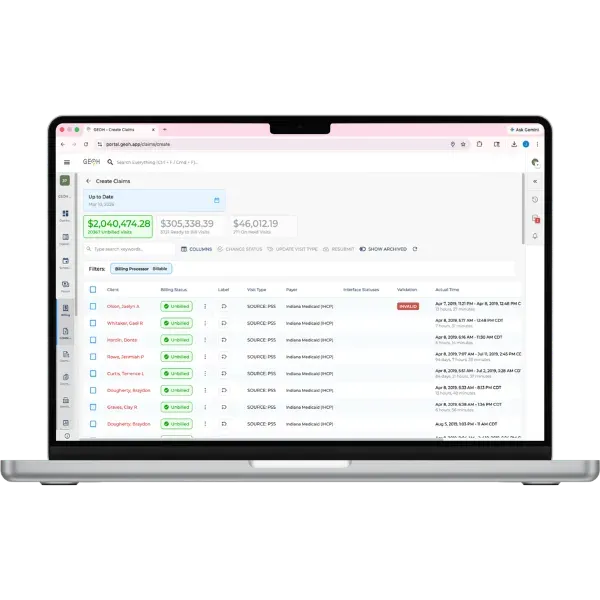
The owner: the person who’s supposed to see all of it at once. Even with the first three roles working well, someone has to be watching for patterns across the whole agency: which waiver types are underutilized, which caregivers have expiring credentials, which authorizations are about to lapse. That’s a full-time job on its own, and it usually falls to whoever has the least time to do it. It matters even more given how much turnover already works against agencies. Median caregiver turnover industry-wide sat at 75% in 2024, the lowest mark in several years but still high enough to disrupt scheduling and billing continuity on its own. The Executive Compliance Dashboard puts that oversight in one place, so the owner isn’t stitching it together from four different logins.
When there aren’t four different people
Most small and mid-sized agencies don’t have four dedicated employees to fill these roles. Often it’s an owner doing the scheduling, a caregiver managing their own EVV check-ins, and billing handled by whoever has ten free minutes that day.
When one person is playing all four roles, something almost always slips, not because that person isn’t capable, but because reimbursement isn’t actually a single job. It’s four jobs stacked onto whoever has the least backup. A visit verification gets checked a day late because nobody’s watching for it in real time. An authorization renewal gets missed because it’s competing for attention with intake calls and payroll. A claim goes out with a small error nobody had time to catch before it turned into a denial. Each one looks small in the moment, and each one is exactly the kind of gap that shows up later as unbilled revenue.
That was Quiana Harlin’s situation. She was running her agency completely alone, watching Facebook groups fill up with panic over MCE changes, and trying to be the scheduler, the biller, and the owner all at once. With GEOH’s Billing Plus package, she effectively added a full team, scheduling, billing, and caregiver management, for a few hundred dollars a month. “I cannot stress to you how great that is for me, being by myself. I can finally take a breath,” she said. Her agency has since tripled in size. Read Quiana’s full story here.
Whether that team is made up of your own employees or GEOH’s, the principle is the same: reimbursement holds together when every role in that chain has a clear owner and the tool to do the job right.
Find out where your chain is breaking
If you’re not sure where the ownership gap is in your own agency, that’s the first thing to find out, before adding another tool to the pile. Get a free billing analysis and see exactly where claims are stalling in your process. Or book a call with GEOH to talk through whether your agency needs better tools, a clearer division of who owns what, or a team to hand it to entirely.
Copyright © GEOH 2026