
The Hidden Cost of Scheduling Mistakes: Paying Caregivers for Visits Medicaid Won't Cover

Your caregiver showed up. They clocked in, did the work, and clocked out. Your agency still can’t get paid for it.
That’s not a hypothetical. It happens every week at home care agencies, usually for one of three reasons: the visit fell outside the client’s authorization window, the EVV record didn’t match the billing details, or the correction window closed before anyone caught the problem. Either way, the caregiver worked. The agency eats the cost.
If that sounds familiar, your scheduling process is where the fix starts.
Every schedule you build is a billing decision
Scheduling feels like a giant task. Who’s available, who’s a good fit for the client, who can cover the shift. But in home care, every shift you confirm is also a bet on whether that visit will be billable.
A visit only gets paid if a few things line up:
- The caregiver’s credentials and background check are current
- The shift falls inside the client’s active authorization period
- The EVV record matches the authorization on service code, time, and location
Miss any one of those, and you’ve got a visit that happened, got documented, and still can’t be billed. That’s the gap where agencies end up paying caregivers out of pocket for work Medicaid will never reimburse.
Where unbillable visits actually come from
Most unbillable visits don’t come from bad care. They come from small mismatches that snowball:
A late clock-in. The caregiver walks in, starts helping the client, and remembers to clock in 20 minutes later. Now the timestamp doesn’t match the scheduled window.
GPS drift. Apartment buildings, rural addresses, and weak signal areas can throw off location verification, even when the caregiver is standing in the client’s living room.
Manual fixes that hide the real problem. A coordinator corrects a timestamp by hand, so the caregiver gets paid. The visit goes through, but your EVV compliance score quietly takes a hit, and the state notices the pattern.
Unit rounding. If a caregiver doesn’t work for the appropriate number of minutes and you round up to the next unit, you’re looking at trouble.
None of these are caregiver problems. They’re scheduling and monitoring problems, and they show up on your books either as a payroll expense with no matching revenue, or as a claim denial you find out about weeks later.
The fix isn’t more effort. It’s earlier alerts.
The agencies that don’t lose money this way aren’t working harder. They’re catching the mismatch before the caregiver ever clocks out, not during Monday morning’s billing review.
That means:
- Flagging a missed or late clock-in the moment it happens, not after the visit
- Checking the EVV record against the authorization in real time, not in a batch at week’s end
- Building a clear process for “verified but not billable” visits, so they get resolved fast instead of sitting in a queue until the correction window closes
If your team is manually cross-checking three different systems to figure out whether a shift is even billable, you don’t have a scheduling problem. You have a visibility problem.
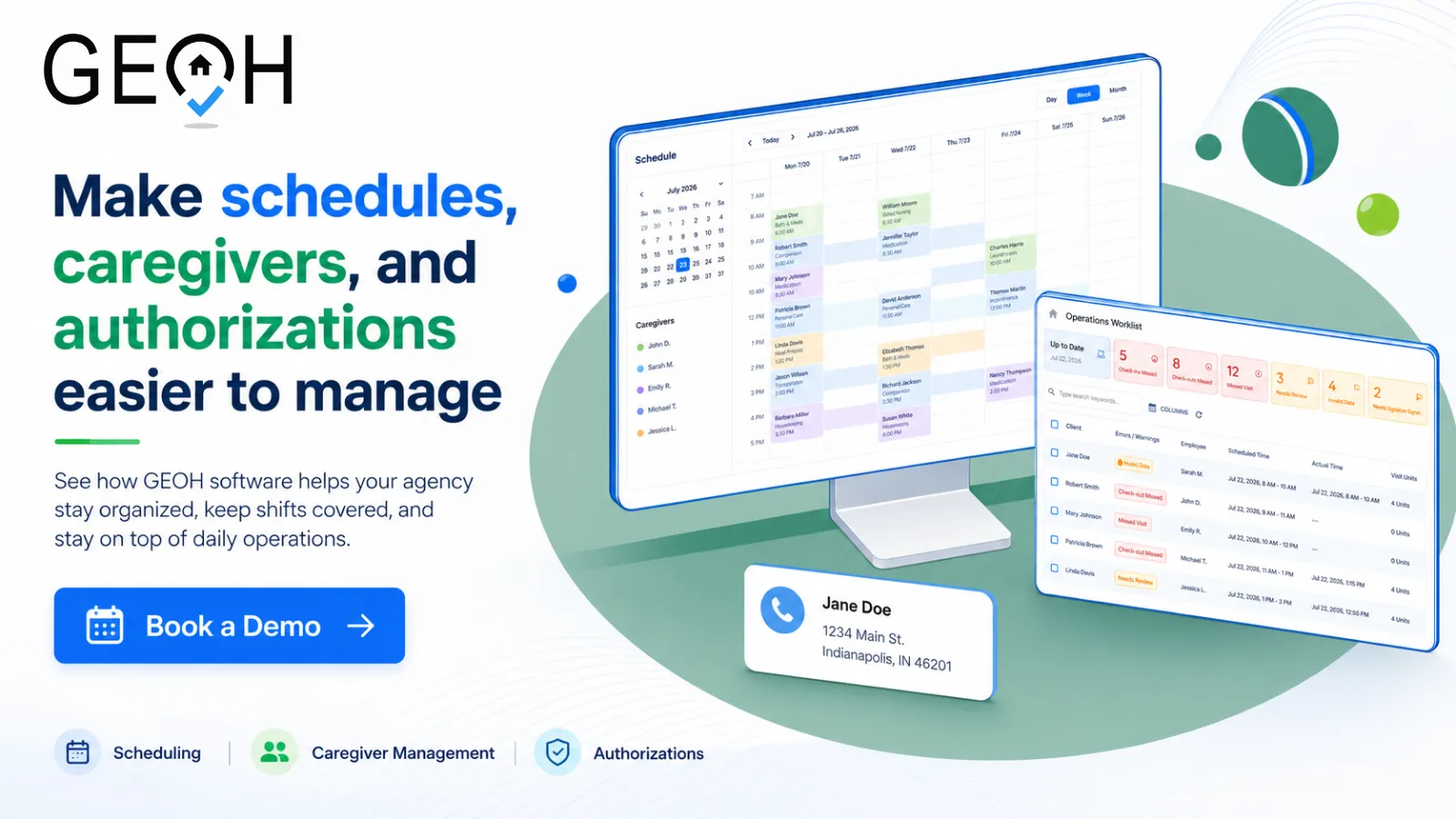
That’s exactly what GEOH’s operations worklist is built to solve. Instead of your team discovering a mismatch during the billing run, a worklist surfaces every flagged visit, late clock-in, GPS mismatch, expiring authorization, in one place, as soon as it happens. Your team works on one list instead of digging through three systems, and every exception gets caught while there’s still time to fix it, not after the correction window has already closed.
Don’t just protect hours. Use all of them.
Here’s the part agencies miss just as often: authorization management isn’t only about staying under the limit. It’s about making sure clients get every hour of care they’re already approved for.
Two things typically go wrong, and they pull in opposite directions:
Authorizations expire unused. If a renewal isn’t requested in time, services delivered during the gap aren’t billable, no matter how medically necessary they were.
Authorized hours go underused. If nobody’s comparing scheduled hours against authorized hours on a regular basis, you can end up delivering, and billing, fewer hours than the client is entitled to. That’s not just lost revenue. That’s a client not getting the full care they qualify for.
An agency can lose real money every month simply by letting a few approved hours sit unscheduled. Multiply that across your caseload and it adds up fast, in dollars and in care your clients aren’t receiving.
What this looks like in practice
Agencies that manage this well tend to do a few things consistently:
- Re-verify Medicaid and Managed Care eligibility on the 1st and 15th, not just at intake
- Cap the number of visits scheduled against a pending (not yet approved) authorization
- Set utilization alerts at 75% and 90% of authorized hours, with a hard stop before scheduling exceeds the limit
- Sync schedules automatically when a plan of care changes, instead of relying on someone to catch it manually
- Keep the same caregiver on a case where possible, for continuity and fewer authorization surprises
None of this requires more staff. It requires a system that connects scheduling, EVV, and authorization data so your team sees the full picture before a shift is ever confirmed, not after a claim gets denied.
How GEOH closes this gap
This is exactly what GEOH’s scheduling and authorization tools are built to catch.
Our scheduling tools check each shift against the client’s active authorization, so your team isn’t finding out about a mismatch after the visit already happened. Our authorization tracker keeps a live count of hours used versus hours approved, so you can see underused authorizations before they expire and overused ones before they turn into a denial.
And if you’d rather not manage any of it yourself, that’s what our Executive Package is for. Our team handles the scheduling oversight, authorization tracking, and exception resolution directly, so visits get scheduled correctly, hours get used fully, and your staff isn’t stuck cross-checking systems by hand. You get the outcome without adding the work to your plate.
Want your team out of the weeds on scheduling and authorizations? The Executive Package puts GEOH’s team behind the scenes handling scheduling oversight, authorization tracking, and exception resolution for you.
The bottom line
You shouldn’t have to pay caregivers out of pocket for an unbillable visit, and your clients shouldn’t miss out on hours they’re already approved to receive.
Both problems come from the same root cause: scheduling that isn’t connected to your authorization and billing data in real time.