
Eliminate Manual Work: Software Solutions for Efficient Home Care!
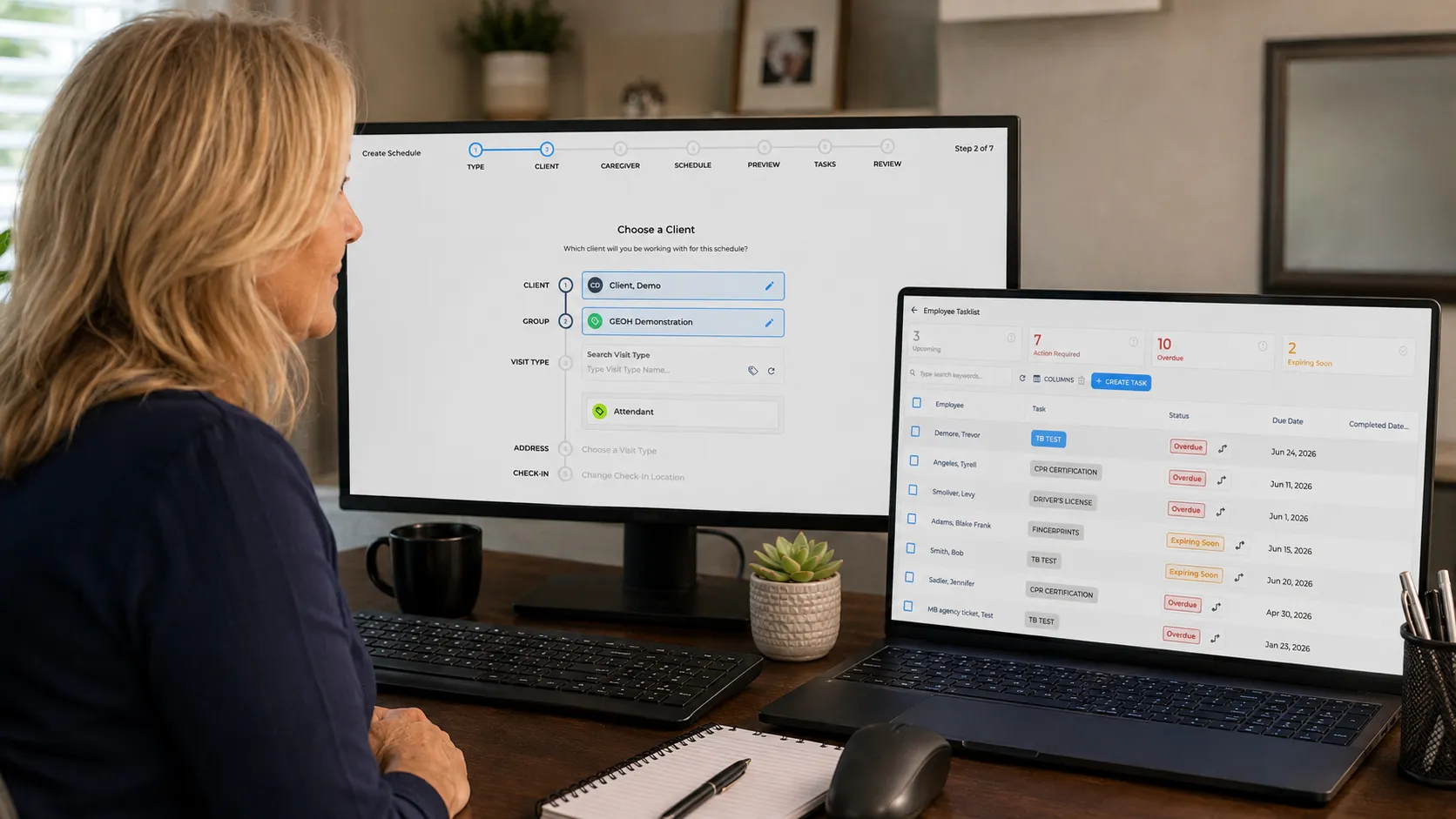
How many times this week did someone on your team re-type information that already existed somewhere else in your system? How many hours went to chasing down a denied claim, tracking an expired certification nobody caught in time, or rebuilding a schedule by phone because a caregiver called out?
Most owners have never actually counted it. None of it feels like a big deal in the moment, one re-entered address here, one denied claim there. Added up over a year, it’s the difference between a team that has time to grow the agency and a team that’s permanently one step behind.
Here’s where that manual work actually hides, task by task, and what it takes to get rid of it.
Scheduling: built by best guess instead of by system
A lot of agencies still build the week’s schedule with a spreadsheet, a stack of sticky notes, and a phone. A caregiver calls out, someone works down a contact list until they find coverage, and the update gets written on a sticky note, typed into the spreadsheet, and then repeated over the phone to make sure everyone’s looking at the same information. It works, until it doesn’t, usually right when a double booking slips through unnoticed because it only ever existed in someone’s head or on a note that got lost under a coffee cup. When scheduling runs through spreadsheets, paper calendars, or several disconnected tools at once, errors like that become close to inevitable (Healthcare Business Today).
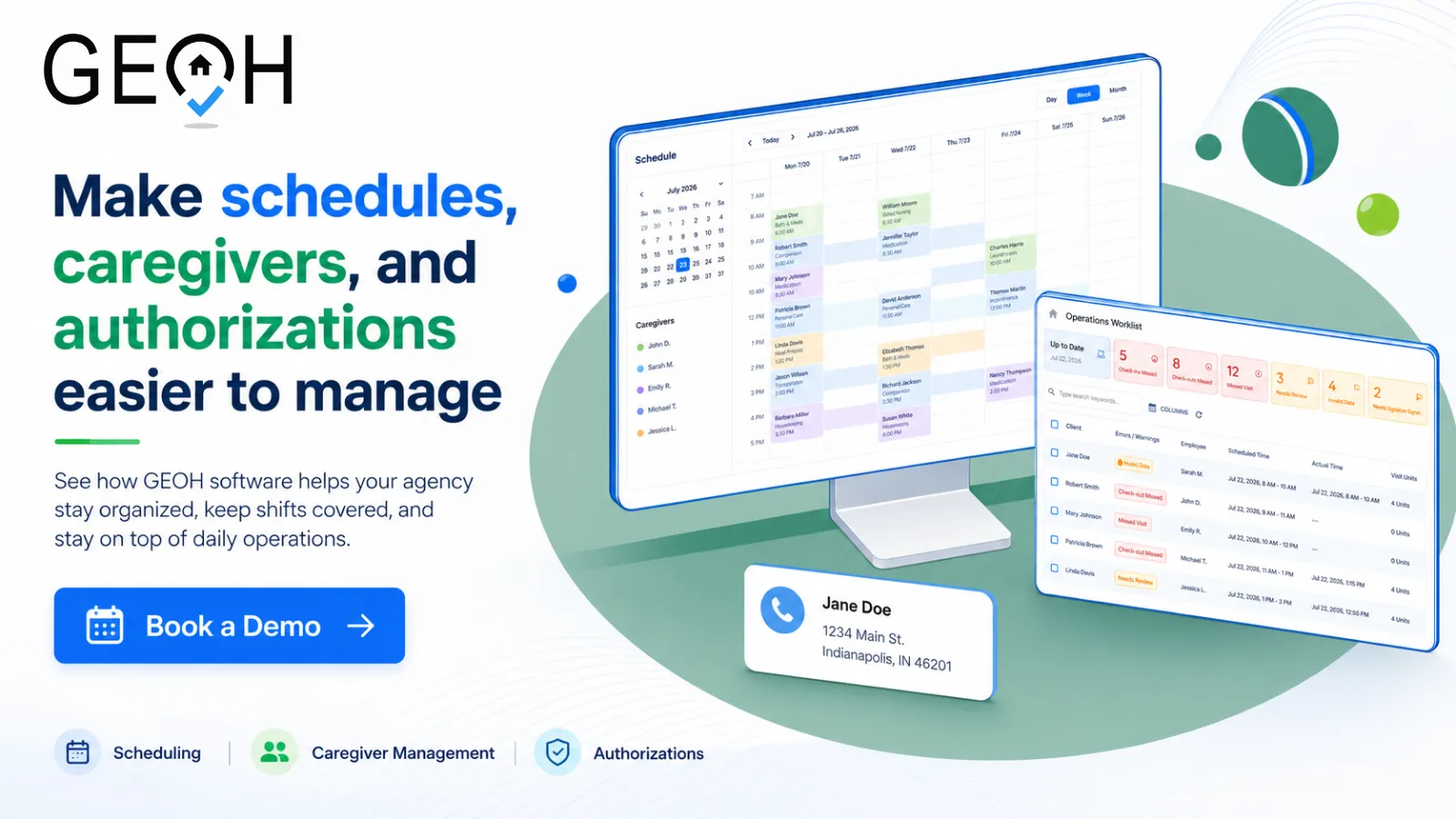
GEOH’s SMART Scheduling scans the schedule automatically for double bookings, overtime risk, and travel times that don’t add up, so a conflict gets caught before a caregiver ever gets sent into it. Open shifts can be posted for qualified caregivers to claim directly, which cuts out a lot of the phone tag that eats up a coordinator’s morning. Scheduled and authorized units are tracked automatically too, so a schedule change doesn’t quietly turn into an unbillable visit down the line.
Visit verification: still uploading files by hand
Electronic Visit Verification isn’t optional. The 21st Century Cures Act requires it for Medicaid-funded personal care and home health visits, and states that fall short risk a reduction in federal Medicaid funding (Medicaid.gov). Plenty of agencies meet the requirement but still do it the hard way: exporting visit data and manually uploading it to the state aggregator every reporting period, then manually working through any mismatches that come back.
GEOH’s EVV formats and submits visit data to your state aggregator automatically, so there’s no manual upload step. Caregivers check in and out with a tap, GPS-verified against the client’s address, and if a visit doesn’t match up on location, time, or is missing entirely, you’re alerted right away instead of finding out weeks later when a claim bounces. Visits still get completed even without a phone signal, which matters if your caregivers cover rural routes.
Billing: chasing denials instead of preventing them
This is usually where manual work costs the most real money, because it’s the one most agencies don’t notice until a denied claim shows up weeks after the visit happened. Someone has to figure out why it was denied, track down the missing piece, correct it, and resubmit, often while the timely filing window is closing.
GEOH’s SMART Bill checks claims against payer rules, authorization limits, and EVV data before they’re ever submitted, which is meant to catch the kind of error that causes a denial in the first place. When something does get denied, it’s automatically flagged with the reason, so your team can fix it and resubmit with a click instead of starting the research from scratch. Submitted, pending, and paid claims are tracked in real time, so nobody has to build a status spreadsheet to know where the agency’s money actually is. If you want a clearer picture of where your agency’s claims are leaking revenue right now, GEOH’s free billing analysis can show you.
Caregiver credentials: tracked in a filing cabinet, not a system
Certifications and licenses all expire on their own schedule, and if nothing is watching those dates for you, the first time you find out one has lapsed is usually the worst possible time to find out. It’s also one of the more common findings when a surveyor pulls a file sample.
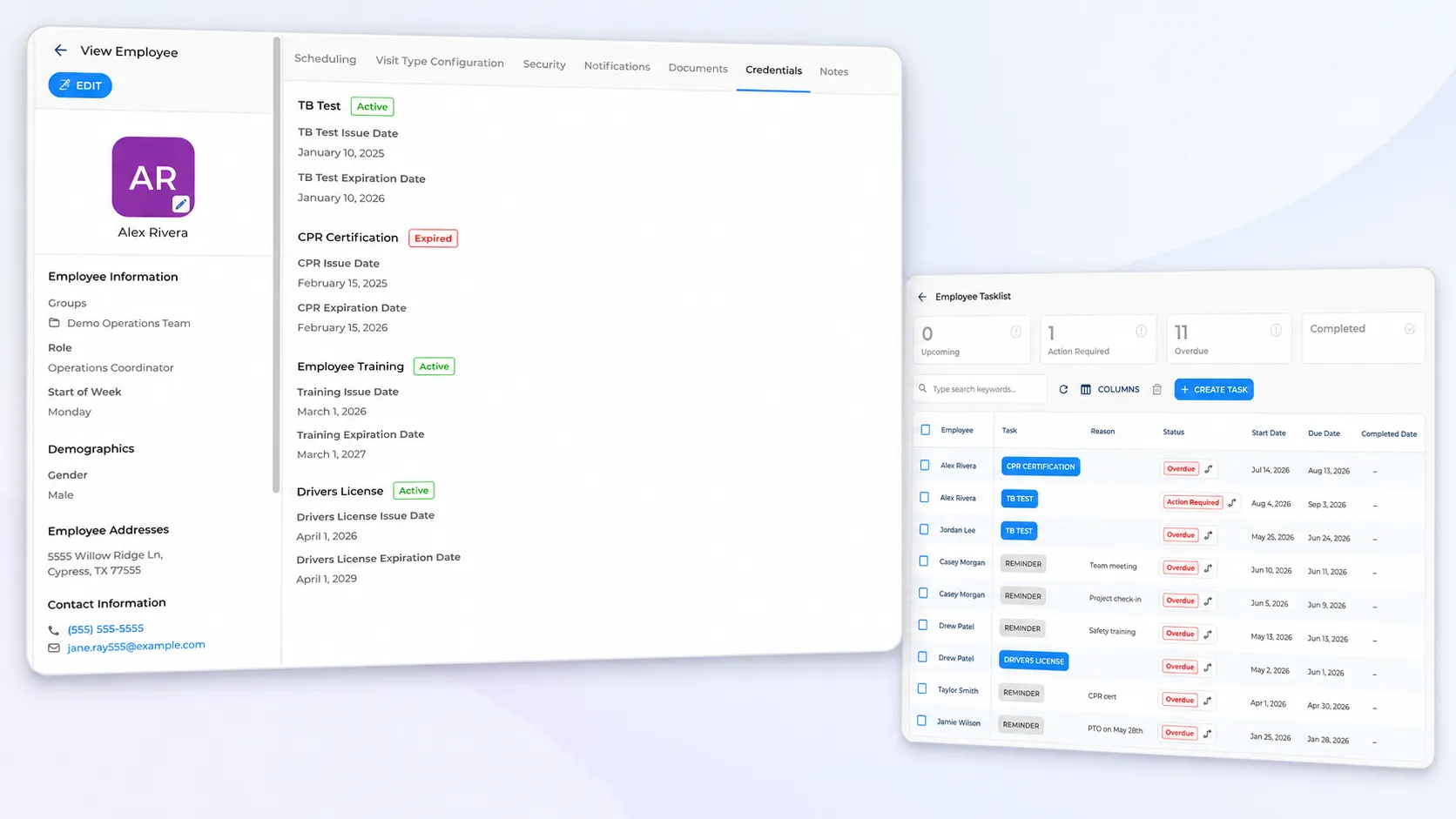
GEOH’s Caregiver Management tracks certifications, licenses, and training requirements, and sends an alert before they expire instead of after. New caregivers get onboarded through a streamlined process instead of a stack of paperwork, and performance data on attendance and visit completion is tracked automatically, so a pattern shows up as a pattern instead of getting noticed only after a client complains.
The part that makes it worse: none of these systems talk to each other
Here’s what usually turns a manageable amount of manual work into an overwhelming amount: scheduling lives in one app, EVV lives in another, billing runs through a third, and caregiver files are split between a spreadsheet and a filing cabinet. A client’s authorized hours get entered once for scheduling and then re-entered for billing. A caregiver’s certification gets tracked in one place but checked against the schedule in another. Nothing updates automatically anywhere else, so every change has to be repeated by hand across every system it touches.
That’s the quiet multiplier behind all the manual work above. It’s not just that scheduling is manual, or that billing is manual. It’s that they’re manual and disconnected, so a single change (a caregiver calling out, an authorization getting updated, a certification expiring) has to be manually carried across three or four separate tools before the whole agency is working off the same information.
GEOH runs scheduling, EVV, billing, and caregiver management from one platform instead of stitching several vendors together. An authorization entered once shows up correctly in both scheduling and billing. A caregiver’s certification status is visible from the same record used to build the schedule. Visit data flows straight from EVV into the claim, instead of getting exported from one system and re-entered into another. The individual features matter, but running them from one place instead of four is what actually keeps the manual work from piling back up.
What it adds up to
None of these are dramatic changes on their own. A conflict caught before it happens. A claim scrubbed before it’s denied. A certification flagged before it expires. But manual work rarely announces itself as a crisis. It shows up as a slightly longer billing cycle, a coordinator who’s always a step behind on scheduling, a denial that could have been caught before it ever went out. The agencies fixing this aren’t necessarily working harder. They’ve just removed the steps that never needed a person doing them by hand in the first place.
With home health and personal care aide jobs projected to grow 17 percent between 2024 and 2034 (BLS), the agencies that can operate efficiently now are the ones that will be able to take on that growth instead of getting buried under it. GEOH currently holds a 4.9 out of 5 rating across 147 verified reviews on Capterra, largely from agency owners who point to exactly this kind of time saved. You can see how other agencies have put it to work in our customer stories.
Add it up for real this week, the re-entries, the callbacks, the claims you had to chase. Whatever number you land on, that’s roughly what manual work is costing you every single week of the year.