
The All-in-One Home Health Software You Can't Afford to Miss!

If your agency runs on several different systems, one for scheduling, one for EVV, one for billing, and a spreadsheet or two to hold it all together, you already know how much time gets lost just moving information from one place to another. What you may not realize is how much it’s actually costing you.
None of these tools are bad on their own. The problem is what happens between them. When systems don’t talk to each other, small things slip through: a certification that lapses without anyone noticing, a visit that doesn’t sync properly, a claim that gets denied for a reason nobody catches until weeks later. Each gap looks minor by itself. Together, they slow your whole agency down.
That’s the real case for all-in-one home health software. Not that it looks cleaner, but that it closes the gaps where agencies quietly lose time, money, and staff.
What “all-in-one” actually means
A lot of platforms call themselves all-in-one just because scheduling and billing sit under the same login. That’s bundling, not integration. The real test is simpler: when something happens in one part of the system, does everything downstream update automatically, or does someone still have to notice it and fix it by hand?
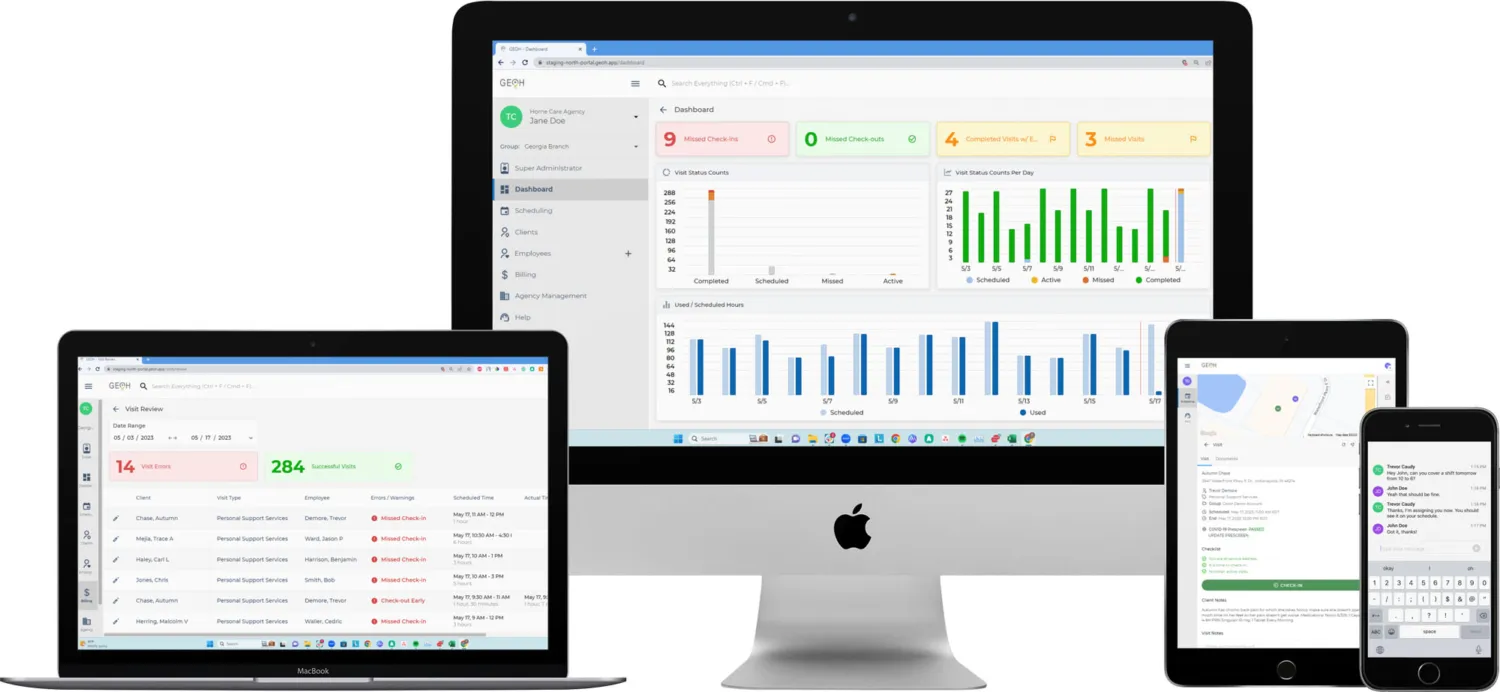
In a genuinely connected platform, scheduling is tied to caregiver credentials, so a lapsed certification blocks a shift instead of slipping through. EVV check-ins feed straight into billing, so visits don’t need to be manually matched to claims. And a flagged mismatch shows up on the dashboard your team already checks, instead of sitting in a separate portal nobody remembers to log into.
Several disconnected systems means several different costs
Fragmentation rarely shows up as one big expense. It shows up as a lot of small ones that add up over time.
Billing. When scheduling, EVV, and billing all live in separate systems, someone has to manually reconcile them, and that’s where errors get through. A mismatched authorization or a visit that didn’t sync cleanly usually isn’t caught until the claim comes back denied. At that point you’re paying for it twice: once in caregiver wages, and again in the staff time it takes to research the denial and resubmit.
Compliance. States are required to collect Electronic Visit Verification data for Medicaid-funded personal care and home health visits, and agencies that fall short risk reduced federal funding (Medicaid.gov). When EVV data lives apart from scheduling and caregiver records, compliance issues are a lot harder to catch before they turn into audit findings.
Staffing. Caregiver turnover across the industry has hovered between 75 and 80 percent in recent years (HCAOA), and disorganized scheduling is part of what drives it. Every time a caregiver leaves, someone has to rebuild that schedule, often across multiple tools instead of one. With home health and personal care aide jobs projected to grow 21 percent through 2033 (BLS), agencies that can staff efficiently are the ones positioned to grow with that demand instead of getting buried by it.
Time. This one is easy to overlook because it doesn’t show up as a dollar amount, but it’s real. Every time someone has to re-enter the same information in a second or third system, that’s time not spent on scheduling, client calls, or catching problems early. Multiply that across a team and a full year, and it adds up to a meaningful chunk of payroll spent on work the software should be doing automatically.
None of these costs show up as a single line item. They show up in denied claims, missed compliance flags, wasted staff hours, and caregivers who leave because the back office couldn’t keep up.
What changes when everything’s connected
When one platform handles all of it, a caregiver checks in and that visit moves toward billing automatically, no manual matching required. If something doesn’t match, it gets flagged right away instead of surfacing weeks later as a denial.
Caregiver management lives in the same system as scheduling, so credentials and shifts stay in sync. Claims get scrubbed against payer rules before they’re ever submitted, catching errors before they become denials. And the executive compliance dashboard shows authorizations, credentials, and outstanding flags in one place, updated in real time, instead of spread across four different logins.
That’s the real value of all-in-one software. Not more features, just fewer gaps for things to fall through, and less time spent stitching systems together that should already be working as one.
How to tell if a platform is really connected
Before you commit to any software, ask a few simple questions. Does a scheduling conflict get caught automatically? Does an EVV mismatch actually stop a claim from going out, or does it just sit in a report nobody checks? Can your team see caregiver credentials, authorizations, and billing status without switching screens?
If the answer is “sort of” to any of those, you’re probably looking at a bundle, not a real platform.
GEOH was built around the idea that a home health agency shouldn’t need five logins to run one business. Over 800 agencies run on it, and it holds a 4.9 out of 5 rating on Capterra, based on more than 150 verified reviews. Many of those agencies made the switch from exactly the kind of fragmented setup described above. You can see what that looks like in their customer stories.
If you’re not sure how much fragmented billing is already costing your agency, that’s worth finding out. GEOH offers a free billing analysis that reviews your actual claims and shows you what’s slipping through, no commitment required.
The software you’re running probably isn’t broken. It’s just disconnected, and in an industry with tight margins and high turnover, that’s the part you can’t afford to miss.