
Illinois Medicaid Claims Denied? 7 Things Home Care Agencies Should Check First
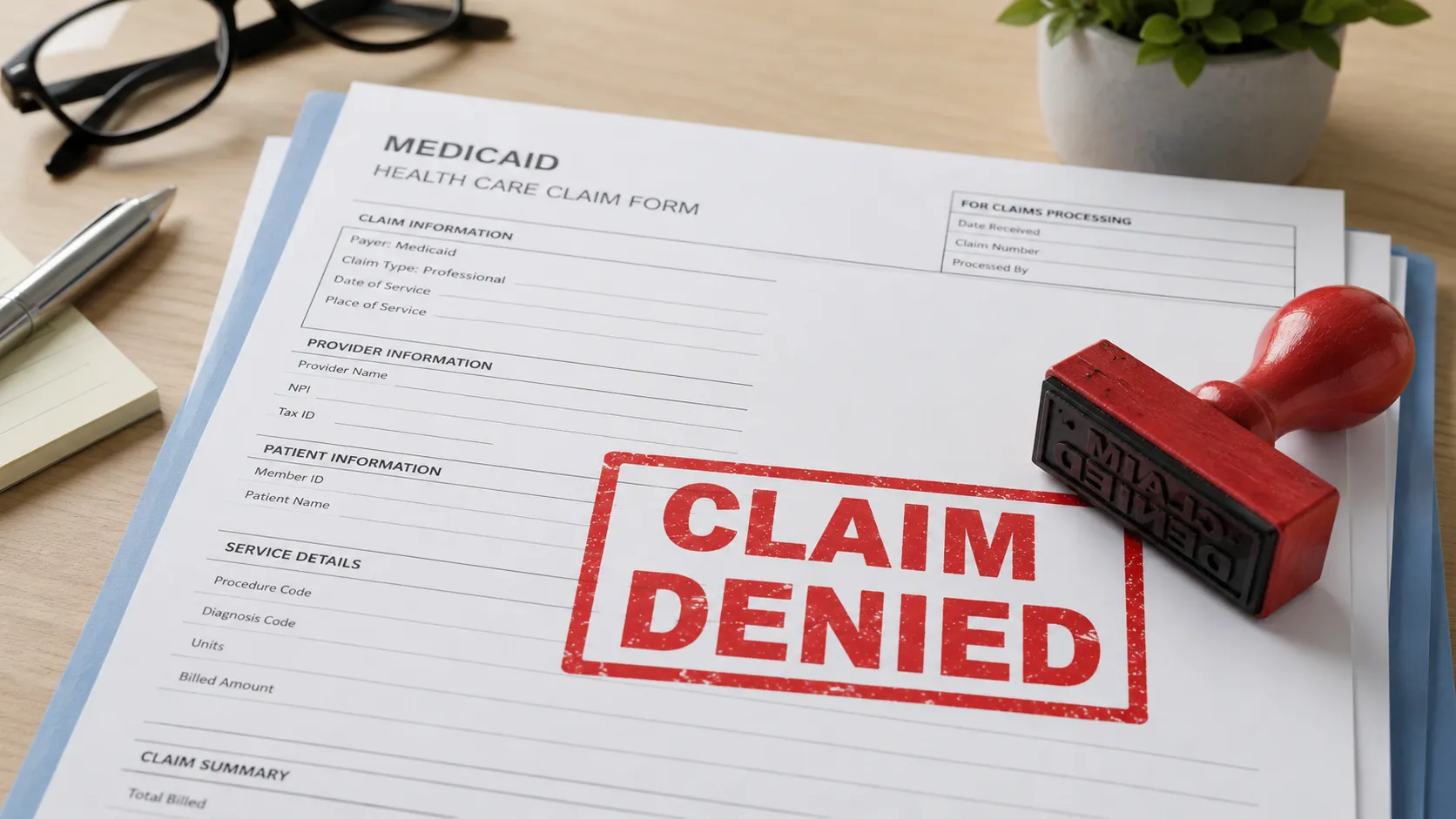
You did the work — the caregiver showed up, the visit happened, the notes are in. So why isn’t the money showing up?
Every denied or rejected claim is a visit you already paid your caregiver for. But most Illinois Medicaid denials trace back to the same short list of fixable causes, not bad luck — and in 2026 there’s a new one to watch. Here are the 7 things to check first when your claims start coming back unpaid.
Why do Illinois Medicaid home care claims get denied?
Most home care claims aren’t denied for complicated reasons — they bounce for common, preventable problems like eligibility mismatches, EVV exceptions, missing authorizations, and late filing. The important distinction is rejection vs. denial, because they’re handled differently:
- Rejected = the claim never entered the payer’s system; something was missing or didn’t match, so it bounced before processing (you’ll see this on your 277CA). You correct it and resubmit.
- Denied = the claim entered the system but the payer decided not to pay. You fix and resubmit, or dispute it.
Either way the clock is already running: for most home care and home health services, you have 180 days from the date of service to get a clean claim in. Miss that and the money is usually gone.
The 7 most common Illinois Medicaid denial causes (quick reference)
| # | What to check | What it looks like | How to fix it | Clock |
|---|---|---|---|---|
| 1 | Client eligibility / member match | Rejected before the MCO sees it; ID/RIN/DOB mismatch on the 277CA | Verify in MEDI, correct member data, resubmit | 180 days from DOS |
| 2 | EVV verification | Visit has an unresolved exception; not “verified” | Clear the exception so the visit is billable | 180 days from DOS |
| 3 | Prior authorization | Auth missing, expired, or units used up | Confirm active auth covers the date/units, then bill | 180 days from DOS |
| 4 | Timely filing | Claim filed past the deadline | File within the window; HFS 1624 override if eligible | 180 days (2 yrs Medicare) |
| 5 | Right payer / TPL | Billed FFS instead of MCO, or skipped other insurance | Confirm the payer and bill primary insurance first | Varies by payer |
| 6 | Codes & modifiers | Wrong code, missing modifier or :DOA/:DRS suffix | Correct the code/modifier and resubmit | 180 days from DOS |
| 7 | Enrollment / revalidation | Provider file lapsed or revalidation overdue | Complete IMPACT enrollment/revalidation, then bill | 180 days from update |
1. Is the client actually eligible right now? (the new 2026 ACE edits)
Check the client’s Medicaid eligibility in MEDI for the exact date of service before you bill — this is now the #1 thing stopping Illinois MCO claims in 2026. Illinois rolled out new “ACE” (Advanced Communication Engine) member edits that verify eligibility before a claim is passed to the MCO. If the member ID, Medicaid RIN, date of birth, or eligibility dates don’t match the state’s records, the claim bounces back to you and never reaches the plan.
These edits turn on plan by plan through 2026, and they target the three most common rejection reasons: subscriber ID not found, RIN that doesn’t match a Medicaid ID, and a DOB or eligibility dates that don’t match the state file. The rejection shows on your 277CA — so if claims are vanishing without an MCO response, look here first. (These apply to MCO claims, not fee-for-service.)
When the ACE member edits go live by MCO:
| MCO | Go-live date (2026) |
|---|---|
| Meridian | April 23 |
| Aetna | May 7 |
| BCBS | May 21 |
| CountyCare | June 4 |
| Molina | June 18 |
Fix: pull the client up in MEDI for the date of service (not today’s date), confirm the RIN, name, and DOB match exactly, then resubmit the corrected claim.
2. Did the EVV visit actually verify?
A visit is only billable once it’s “verified” — meaning it has no unresolved EVV exceptions. If the visit is missing a required data element, the captured location, or a caregiver profile is missing a valid nine-digit SSN, it sits in exception status and your claim gets held up or denied.
This matters more in 2026 on two fronts. IDoA and DRS providers (your CCP and HSP clients) went live on HHAeXchange March 2, 2026 — for many agencies, billing under EVV rules for the first time. And HFS’s updated EVV policy for State Plan HHCS providers, effective April 1, 2026, raised the compliance threshold to 75%, added quarterly compliance monitoring, and set penalties for agencies that fall short (it applies to providers billing Illinois Medicaid, the MCOs, and FIDE-SNPs). An EVV exception isn’t just a compliance flag — it’s an unpaid visit.
Tired of finding these problems on a denial three weeks later?
This is exactly what GEOH is built to catch before the claim goes out. GEOH flags eligibility and EVV problems on the front end, so your claims leave clean instead of bouncing back. Agencies on GEOH see up to 99% of claims paid on the first submission — less rework, and cash that shows up faster. See how GEOH gets you paid faster →
3. Was prior authorization in place — and does it still cover the visit?
Confirm there’s an active authorization covering the date of service, the service code, and the units you’re billing. An expired auth, a used-up auth, or a visit outside the authorized period is one of the most common — and most avoidable — home care denials. For MCO clients, make sure you also followed that plan’s referral/auth rules.
If the auth lapsed or ran out, you’ll need a new or extended authorization before the claim can be paid — and chasing that down after the fact eats into your 180 days.
4. Did you bill within the timely-filing window?
For most Illinois home care and home health claims, you have 180 days from the date of service to file — and that applies to resubmissions too, not just your first try. Blow past it and the claim is denied for timely filing, full stop.
Key exceptions:
- Medicare-denied or crossover claims: 2 years from the date of service.
- Third-party liability (TPL): generally within 180 days after the other insurer’s final decision.
- Retroactive eligibility, provider-file changes, and a few others: may qualify for a manual override using HFS Form 1624, submitted with the claim.
The trap: a claim rejects early, lands in a pile, and gets “fixed” on day 200 — too late. Track the filing deadline on every open claim, not just the date you submitted.
5. Did the claim go to the right payer?
Make sure the claim went to the client’s actual payer — the correct MCO, FIDE-SNP, or fee-for-service Medicaid — and that any other insurance was billed first. Illinois Medicaid is the payer of last resort, so if the client has Medicare or other coverage, that’s billed before Medicaid. The payer on the date of service is what matters, not who the client has today — watch dual-eligible clients and anyone who recently switched plans. A claim sent to the wrong payer burns time you can’t get back on the filing clock.
6. Are the codes and modifiers right?
Double-check the procedure code, modifiers, units, and NPI — small coding errors are a leading cause of denials. One Illinois detail that’s easy to miss: EVV-scope service codes under an MCO authorization carry a :DOA or :DRS suffix depending on the payer (e.g., a DOA-authorized S5130 shows as S5130:DOA from an MCO). Also watch for outdated procedure codes, units that don’t match the authorization, and the wrong NPI. These feel small but add up fast across a high volume of visits.
7. Is your enrollment and revalidation current?
Confirm your agency’s enrollment is active in IMPACT, your HHAeXchange portal is set up, and your revalidation isn’t overdue. If your provider file lapses, claims can quietly reject — and HFS has revalidation underway, with providers who don’t complete it at risk of disenrollment. Note that HHAeXchange provider enrollment is required even if you use a third-party EVV vendor, and provider-file changes (new payee, NPI, specialty) can require an HFS 1624 override if they caused a rejection. An enrollment lapse is a silent revenue killer — nothing looks “wrong” on your end, the claims just stop paying.
How to stop denials before they happen
The agencies that don’t lose money to denials simply catch problems before the claim goes out:
- Daily: clear EVV exceptions so every visit is verified and billable.
- Before billing: verify eligibility in MEDI for the date of service and confirm the authorization covers the visit; scrub codes, modifiers, units, and payer.
- Weekly: review the 277CA and remits for rejections and fix them well inside 180 days. Keep IMPACT, HHAeXchange, and revalidation current.
Running this 7-point check by hand on every claim is the slow way to do it.
GEOH ties EVV, scheduling, and billing together so your claims go out clean automatically — eligibility checked, visits verified, authorizations matched, codes scrubbed. Less time fixing rejections, fewer denials, and faster payments. Billing becomes the easy part instead of the bottleneck. Get paid faster with GEOH — see how →.
FAQs
What’s the difference between a rejected and denied claim in Illinois? A rejected claim never entered the payer’s system — something was missing or didn’t match, so it bounced before processing (you’ll see it on your 277CA). A denied claim made it in but the payer decided not to pay. Rejections are usually a quick correct-and-resubmit; denials may need a correction or a formal dispute.
How long do I have to fix and resubmit a denied Illinois Medicaid claim? For most home care and home health services, 180 days from the date of service — and that deadline applies to resubmissions too. Medicare-denied and crossover claims get 2 years. Some situations (retroactive eligibility, provider-file changes, TPL) can qualify for a manual override with HFS Form 1624.
Can an EVV exception really stop my claim from getting paid? Yes. A visit is only billable once it’s “verified,” with no unresolved EVV exceptions. Missing data, no captured location, or a caregiver profile missing a valid nine-digit SSN can all hold up or deny the claim for that visit.
What are the new ACE member edits and when do they hit my MCO? ACE member edits verify a client’s eligibility before your claim is passed to the MCO. If the member ID, RIN, DOB, or eligibility dates don’t match the state file, the claim is rejected back to you and never reaches the plan. Rollout in 2026: Meridian April 23, Aetna May 7, BCBS May 21, CountyCare June 4, Molina June 18. They apply to MCO claims, not fee-for-service.
Where do I check Illinois Medicaid eligibility before billing? Use the MEDI system, and always check eligibility for the actual date of service — not today’s date or a date range. Confirm the RIN, name, and date of birth match exactly before you submit.
Should you resubmit, correct, dispute, appeal, or escalate? Match the action to the problem:
- Correct and resubmit when the claim rejected for a fixable error — eligibility mismatch, EVV exception, coding, missing info. It never adjudicated, so fix it and rebill inside 180 days. This covers most home care denials.
- Dispute / reconsideration when the claim processed but you disagree with how it was paid or denied. For MCO claims, go through that plan’s internal dispute process first; the MCO assigns a tracking number.
- Escalate to HFS only after exhausting the MCO’s internal process. Unresolved MCO disputes go to the HFS Provider Resolution Portal — no sooner than 30 and no later than 60 calendar days after you submitted to the MCO.
- Appeal is a different track — for denied or reduced services (a member/State Fair Hearing matter), not a billing error you can simply correct.
The takeaway: most home care denials are correct-and-resubmit, not appeal. Don’t burn your timely-filing clock disputing a claim you could have just fixed.
This guide is general information for Illinois home care and home health agencies and isn’t legal, billing, or compliance advice. Always verify current rules, rates, and deadlines directly with HFS and your MCOs, since Medicaid requirements change.
Copyright © GEOH 2026